
In short
- Automated content creation takes over the whole blogging process after the initial setup: keyword research, writing, SEO optimization, publishing.
- Four specialized AI agents (marketing, copywriter, SEO and web developer) build each article one after the other.
- It works best for small businesses with no in-house marketing team. It will not do strategic planning for you, and it is the wrong tool for personal, story-driven writing.
- SEO results need consistent publishing for at least 3 to 6 months. The platform has a 14-day trial, and you get four real articles during it.
Why the blog is often dead weight for a small business, and how AI automation can help
Almost every small business has a blog. Almost none of them post anything new. Owners generally know that regular posts bring in customers. The problem is that writing something worth reading takes time, knowledge and consistency, and those are the first three things a small business runs out of.
That is the gap AI blog automation fills. Strategy stays with you. The routine goes to the system: keyword research, writing, optimization, publishing. Ninorai built its platform to smooth out those steps so a business can spend its attention on ideas and growth instead.
What AI blog automation actually is and what it is not
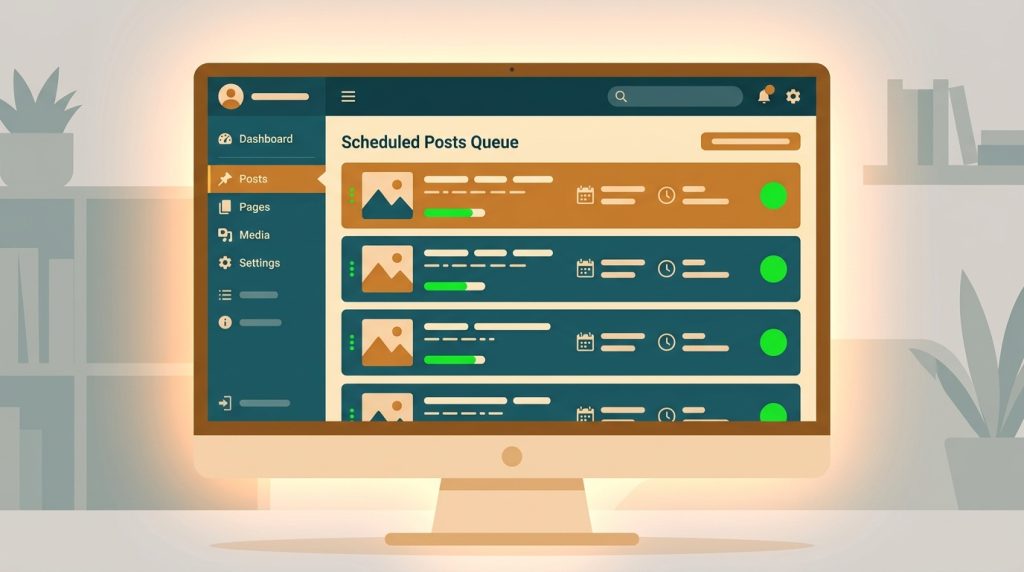
AI blog automation is a system that plans, writes, optimizes and publishes SEO articles on its own, with no manual work needed for each individual post. A business sets it up once. After that it produces and publishes new content on a schedule.

Opening ChatGPT, typing a few words and pasting the result into WordPress is not automation. That is manual writing with a helper. Automation means a repeatable process with clear rules and a predictable output at the end: a finished article that search engines can find and index.
These systems run on natural language processing (NLP) and machine learning. NLP lets the system understand what a topic actually means, not just spot isolated keywords. Machine learning then tunes the content toward the signals Google uses when it ranks pages. In practice that means articles Google can read and put in front of people who are searching.
The wider picture of AI blog automation for small business also covers the strategic side: building authority in a niche.
AI blog automation does not replace strategy. It executes it, week after week, on the same schedule.
The roles of the AI agents in the automated process: how they work together
Content automation at Ninorai runs on four specialized AI agents, each with one clearly defined job. They work in sequence, and what one finishes becomes the starting material for the next.
- The marketing agent researches the market, finds keywords with real search volume and looks at the competition in the SERP. That is how topics with ranking potential get picked.
- The copywriter agent writes a unique article shaped around the specific business and its audience. A built-in originality check confirms that every article stands entirely on its own.
- The SEO agent adds schema markup, meta tags and internal links, then optimizes the content for Google, generative AI search (GEO) and Answer Engines (AEO).
- The web developer agent publishes the finished text straight into the business’s CMS, handling formatting, images and structure.
What the business gets is a finished, optimized article, with nothing to do by hand once the setup is done.
From keyword to published article: step by step
The marketing agent picks a keyword with potential. The copywriter builds the outline and writes. The SEO agent handles every technical element, headings through internal links. The web developer publishes the piece in the CMS.
The whole cycle runs through automatically, and the business ends up with an SEO-optimized article without touching any of the individual steps.
Which businesses AI blog automation suits best and when it is not the answer
Content automation pays off in narrow niches where there is no in-house marketing team and SEO still needs regular posts. Usually that looks like online stores, accounting firms, real estate agencies, B2B service providers and local specialists with a website. They know their subject. They rarely have the hours to write about it every week.
Multilingual content is a serious plus. The software generates content in all major European languages, which helps when a business serves more than one market.
When is it a poor fit? When the writing has to rest on personal stories or a narrative voice: investigative journalism, opinion columns, books. Same answer if a business has no online strategy at all, because there is nothing for the system to execute.
Research on generative AI shows that automation delivers the most value when it replaces repetitive tasks with a predictable output. Pointed at strategic thinking, it tends to disappoint.
AI blog automation vs. traditional methods: when each one works better
| Criterion | Hiring a copywriter or agency | Writing yourself with an AI tool | Fully automated AI system |
|---|---|---|---|
| Time spent by the business | Moderate (briefing and review) | High (writing, optimizing and publishing) | Minimal after the initial setup |
| Monthly cost in euros | High | Low | Predictable mid-range cost (subscription) |
| SEO optimization (schema, links, meta) | Depends on the specialist’s skills | Requires your own SEO knowledge | Built in and systematic |
| Scalability (articles per month) | Limited by capacity | Limited by available time | Easy to scale |
| Technical experience needed | No | Yes | No |
| Publishing consistency | Depends on the budget | Rarely sustained long term | Guaranteed |
With a big enough budget and content that has to feel highly personalized, a copywriter or an agency wins. With time on your hands and SEO knowledge in your head, writing yourself with an AI tool works fine. When you want consistency and have no internal resource to give it, a fully automated system is the practical answer. Ninorai is one platform built that way.
What results a business can expect from AI blog automation and what the limits are
Visible movement in organic search usually takes at least three to six months of regular publishing, and longer in competitive niches. Automation keeps that rhythm going every week, which is the part most small businesses drop first. Rankings next week are not on the table for anyone.
Three things are worth checking before you start:
- CMS integration: the platform works with most popular systems. If yours is not on the list, you can request it.
- GDPR compliance: relevant above all for European businesses that process audience data.
- A 14-day free trial with four real articles: your chance to see whether the output fits your business and your niche.
Four articles are enough to judge the writing on your own topics, in your own niche, before any commitment.
Frequently asked questions
Does a person need to be involved, or is everything fully automatic?
You set the parameters for your business and niche once. After that the system runs on its own: picks the keywords, writes, optimizes and publishes every article.
How many articles can an AI system generate and publish in a month?
Depending on the plan, you get 4 or 8 articles per month. The basic and standard plans include 4 articles of around 1,000 words each. The premium plan includes 8 articles of 1,500 words each plus the full set of SEO tools.
How does AI blog automation integrate with WordPress and other CMS platforms?
It integrates with most popular CMS platforms, WordPress included. If yours is missing, you can always request that it be added.
Is it safe for your data and does it meet GDPR requirements?
GDPR compliance is a baseline for every business in Europe. At Ninorai, data is processed in line with current legislation, and the privacy policy is there to read before you start working with the system.
What is the difference between AI blog automation and hiring a copywriter?
A copywriter gives you full control over style and storytelling, and costs you more money and more time. An automated system fits better when you want regular content on a fixed budget and without managing people.