
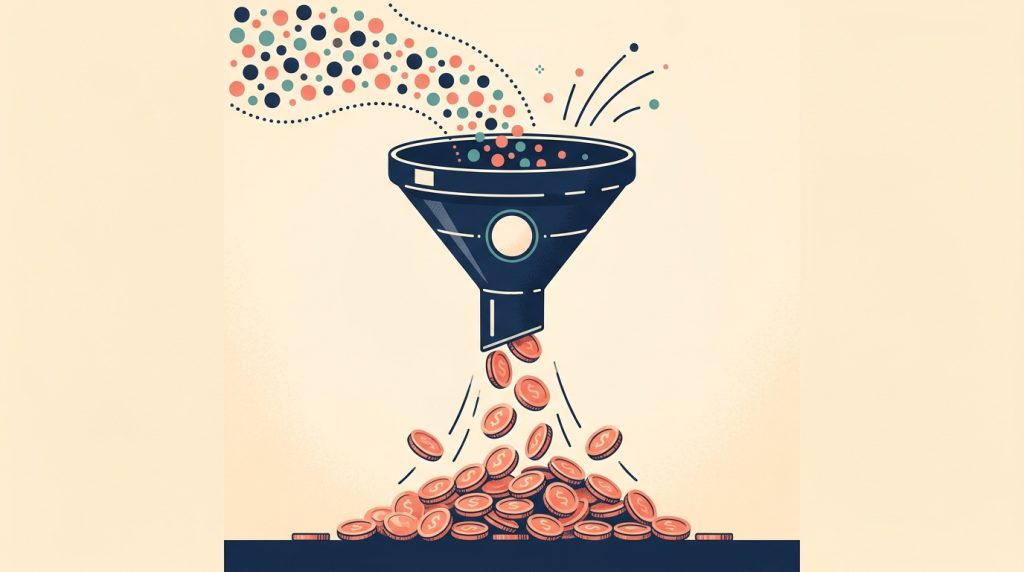
Why your site turns visits into nothing
Why do visitors leave your site without ordering? Pulling people in does not pay the bills if there is no working mechanism for lead generation behind it. Traffic is the easy part. The hard part is the stretch between a click and an actual inquiry, and that is where most sites quietly lose money in 2026.
Contents
- Where the bucket leaks and why traffic does not equal money
- How to make content answer before the question is asked
- How to hold attention with smart automations
- Why a fast reply matters more than perfect design
- How to see the invisible opportunities on your site
- How to systematize the whole process for predictable growth
Where the bucket leaks and why traffic does not equal money
Think of a physical store on a busy main street. People walk in every day, browse the displays and the goods, then walk out without buying anything. At the end of the month the visitor count looks great and the register is empty. That is the classic „leaky bucket“ scenario, and online it looks exactly the same.
Many businesses only work on the top of the funnel. They invest in ads, social media and banners to bring in new visits. Then the visitor lands on the site and finds no clarity, or a path to purchase that takes far too many steps.
The connection breaks where the user’s expectations do not match the reality of the page. The person on the other side is looking for a solution to a specific problem. If your site only talks about „how great we are“ instead of „how we will help you“, trust disappears in seconds.
The mechanics of the loss are simple. Nobody online has much attention to spare. If you fail to point the visitor to the next logical step (a newsletter signup, a resource download or a direct inquiry), you paid for that visit and got nothing back.
| Focus | Result | Risk |
|---|---|---|
| More traffic | More visits | Low return |
| A clear step | More actions | Minimal |
| Optimization | More orders | Controllable |
The marketing budget takes the hit. Customer acquisition cost climbs, because you pay for thousands of visits to win one order instead of fixing the process and closing ten. So move the focus off „more people“ and onto „more action from the people you already have“.
How to make content answer before the question is asked
The psychology of trust has changed. Today’s users are skeptical and well informed. They do not want a pushy sale, they want to be educated so they can decide for themselves.
That is the job of good SEO content for business (Search Engine Optimization, SEO). Keywords are only part of it. The rest is empathy. When you write an article or a service description, step into the customer’s shoes and get ahead of their fears and objections.
- Anticipating fears
- Answers to objections
- Clear benefits
- Expert tone
If you sell accounting software, the customer does not care about price alone. They are asking three things: „Will it be hard to migrate my data?“, „Is my information secure?“, „What happens if I make a mistake?“.
Your business strategy for 2026 has to include content that answers those worries head on. When the reader feels you understand their pain and offer a solution before they ask, trust appears. You stop being one more vendor and become an expert and a partner.
At that point turning traffic into customers stops being a struggle. The prospect thinks: „These people understand my problem, so I can trust them.“ That shortens the sales cycle considerably.
How to hold attention with smart automations
Counting on a visitor to find the contact form on their own and write to you is a gamble. Most people are passive. They read, they scroll, and if nothing prompts them, they close the tab. Your job is to turn observers into participants.
This is the part sales automation handles. Not annoying pop-ups that cover the screen in the first second, but contextual cues.
Say a visitor has been reading your blog post about inventory optimization for 3 minutes now. The interest is obvious. A smart system spots that and discreetly offers: „Want an inventory checklist?“ or „Need help calculating your losses?“.
The mechanism works because of the timing. You offer value at the moment the user is most engaged, which reads as help rather than an interruption.
| Approach | Timing | Effect |
|---|---|---|
| Static form | Random | Low |
| Contextual offer | High interest | Higher |
| Automation | Well timed | Measurable |
The effect of automations like these shows up quickly. More people leave an email or a phone number, because the barrier to contact is low and the offer is relevant. You stop relying on luck and start running the process, which is what steady lead generation actually looks like.
Why a fast reply matters more than perfect design
People expect answers now. If a prospect has a question and gets no answer right away, they go to the competition. You may have the prettiest site around, but if customer inquiry management is limping, you are losing money.
When someone fills out a form or asks a question in chat, they are in a state of high buying readiness. Every delay cools that interest, and the odds of closing the deal drop sharply after the first 5 minutes.
So how do you manage that without sitting in front of a computer around the clock? With virtual assistants and chatbots trained to hold a meaningful conversation.
The virtual assistant greets the visitor, qualifies them (works out what exactly they are after) and either gives a direct answer or books a meeting with you at a convenient time. The waiting disappears, and the customer feels served straight away.
For the business, that means no missed opportunities after hours or over the weekend. Your digital employee works 24/7, keeps communication flowing and keeps lead generation running while you sleep.
How to see the invisible opportunities on your site
Many of your site’s visitors are fully qualified buyers, and they leave in silence. They check the prices, read about the services, never fill out the form. In the Business-to-Business (B2B) sector this happens every single day.
Relying only on the people who „raise their hand“ means leaving money on the table. That is the gap conversion optimization through identification fills.
Technology makes it possible to „de-anonymize“ traffic, to see which company visited your site, how long it spent on the pricing page and which services it looked at. No magic involved. It is analysis of IP addresses and behavioral data, done legally and ethically for business purposes.
That information is worth real money. Instead of making cold calls blindly, your sales team can reach out to a company that has already shown interest. The conversation starts differently: „We noticed you were looking into our logistics solutions…“.
You know who is interested, you know what they are looking for, and you can act first, rather than guessing which campaign did the work.
How to systematize the whole process for predictable growth
Four elements, then: content, automation, speed and identification. They all sound promising, and their technical complexity is exactly what scares business owners off. How do you bring it together into one working machine without hiring an entire IT department?
That is the problem platforms like Ninorai were built to solve. It is software as a service (Software as a Service, SaaS) made for this job, removing the chaos and the technical barriers to growth.
Ninorai pulls several critical processes into a single system. First, the platform automates the creation of high-quality blog content. It does not just generate text, it optimizes it for search engines (Search Engine Optimization, SEO) and for geographic targeting (GEO), so the right people find your site. The traffic problem gets solved without expensive copywriting services.
Second, the system includes a smart virtual assistant that handles first contact, answers questions and makes bookings or inquiries easier. That covers the need for an instant response and tightens up customer inquiry management.
Third, the lead identification tool shows you which businesses are browsing your site and hands you those „invisible“ opportunities.
All of it integrates into your existing site and requires no programming skills. The money you would spend on extra salaries and the hours you would spend on management go back into your product or service instead. One command center rather than five tools that do not talk to each other.
Ready to stop losing customers?
Turning traffic into deals is not a matter of luck, it is a matter of system. Stop treating your site as a static brochure, turn it into an active communication tool, and the results show up fast.
Four things worth remembering:
- Content should solve problems and build trust up front.
- Response speed is critical for closing the deal.
- Not every visitor will write to you, so you need a way to identify the „silent“ interest too.
- Automation is not a luxury, it is a necessity for team efficiency.
Instead of wondering where your marketing money goes, take control of the process. Look at what Ninorai offers and start turning visits into a predictable stream of revenue today.